
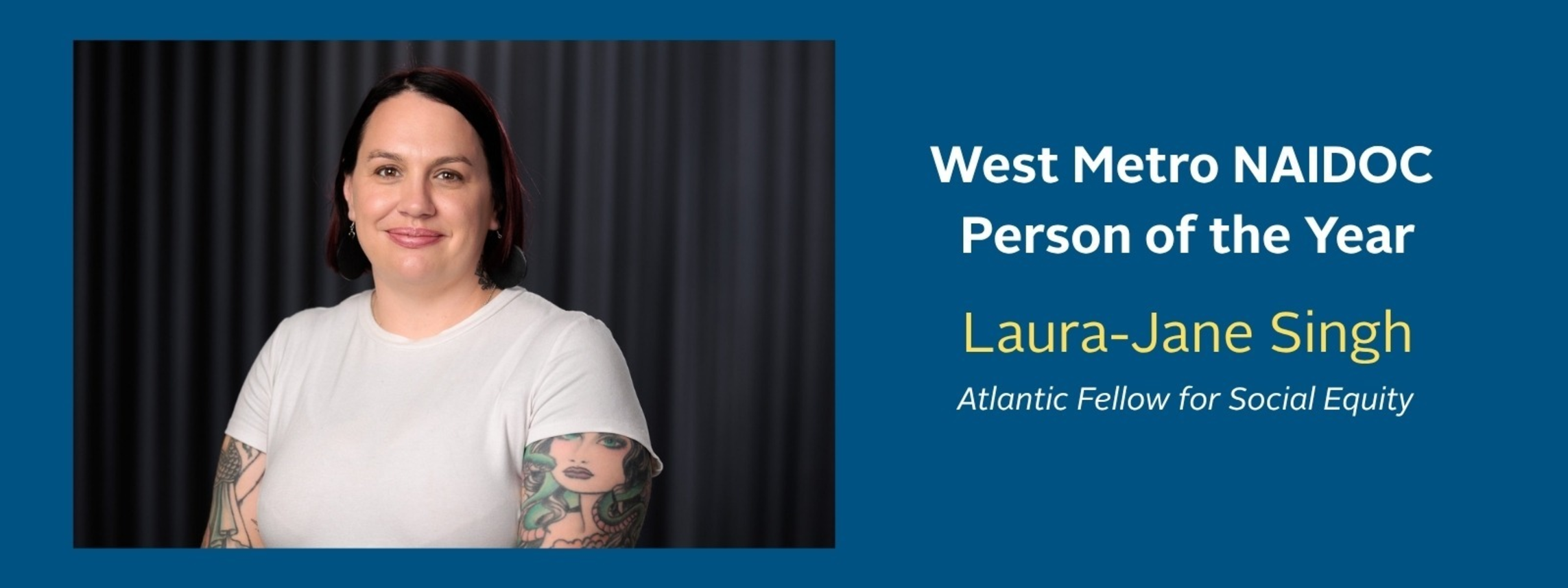
Fellow wins West Metro NAIDOC Person of the Year
Atlantic Fellow for Social Equity, Laura-Jane Singh, recently won the 2026 West Metro National Aborigines and Islanders Day Observance Committee's (NAIDOC) Person of the Year Award. Read her reflections on what winning this award meant to her in the following interview below.
Q: What did winning the West Metro NAIDOC Person of the Year Award mean to you personally and for the community work you lead?
Winning the West Metro NAIDOC Person of the Year Award meant a lot to me, particularly because the community had to nominate me to receive it. It’s really a gift from the community, and I am so grateful. I don’t think you ever do social change work expecting recognition. You do it because you care deeply about your community and want things to be different for the people coming after you.
It was a moment when I could reflect on how far I have come and on all the people who have walked alongside me. None of this work happens alone. For me, the award also recognized the collective work happening across the West — the people who show up, advocate, create spaces for community and keep pushing for change, often without recognition.
I was incredibly proud, but mostly I felt thankful for community and the trust they have in me.
Q: Is there a specific moment or milestone in your journey that felt like the turning point leading to this recognition?
I don’t know if there was one single turning point. My journey has been made up of lots of moments, some really difficult ones, and others that reminded me exactly why I keep doing this work.
If anything, the biggest shift for me was learning that I didn’t have to separate my lived experience, my professional knowledge and my Aboriginal identity to be considered a leader. For a long time, I thought leadership meant fitting into particular spaces or doing things in a certain way. Over time, I realized that some of my greatest strengths come from bringing all of those parts of myself together.
That changed the way I approached my work. I became much more comfortable challenging systems, speaking up when something wasn’t right and creating space for community voices, particularly those who are too often excluded from the conversations that directly affect them.
Q: How has being an Atlantic Fellow for Social Equity influenced your approach, leadership or perspective?
Being an Atlantic Fellow for Social Equity has really strengthened the way I think about leadership and social change. It allowed me to think more openly about individual programs/services and look more deeply at systems: who holds power, whose knowledge is valued, who gets to make decisions and who is missing from the table.
One of the biggest things I have taken from the Fellowship is that meaningful change has to be relational. It comes from community, from listening, from being accountable and from recognizing that lived experience and cultural knowledge are forms of expertise.
It has also made me more confident in my own leadership. I don’t feel like I need to replicate traditional models of leadership. I can lead quietly and in a way that centers culture, lived experience, relationships, reciprocity and community, while remaining willing to challenge systems and advocate for structural change.
Q: What piece of advice would you give to emerging leaders striving to create positive change in their communities?
Don’t underestimate the value of who you already are and what you already know.
You don’t need to have the loudest voice in the room, the biggest title or all the answers to be a leader. Some of the strongest leadership I have witnessed happens quietly; people showing up consistently, caring for community, creating opportunities for others and doing what they said they would do.
Stay true to your values and connected to your community. Listen more than you speak, be willing to learn and don’t be afraid to challenge what isn’t working.
And importantly, bring people with you. Leadership shouldn’t just be about opening a door for yourself; it should be about holding that door open so others can walk through too.
Since completing the fellowship, I have had people open doors for me, mentor me and bring me into spaces I could never have imagined being in, and it’s humbling. I am so grateful for such experiences, as they guide all that I have done and hope to do.
Atlantic Fellow for Social Equity, Laura Jane-Singh is a Quandamooka woman and project lead for Aboriginal-led, kinship care model redesign at The Victorian Aboriginal Children and Young People’s Alliance. She works to create trauma-informed, culturally safe spaces and services that center traditional healing practices to promote collective care, connection, relationality and resilience.